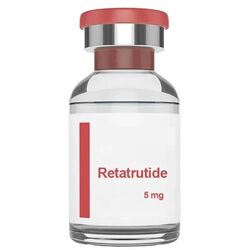
What Is Retatrutide (GLP-3)
Retatrutide is a triple hormone (GIP, GLP-1 and glucagon) receptor agonist in development for the treatment of obesity.
Following the emergence of Ozempic (semaglutide) and Mounjaro (tirzepatide), Retatrutide has demonstrated even greater weight loss outcomes in clinical studies, setting a new benchmark in research.
This medication represents a synthetic peptide, which research indicates functions as a triple agonist. This compound comprises a 39-amino-acid sequence, engineered as an analog to the gastric inhibitory polypeptide (GIP), with additional affinity observed towards the glucagon-like peptide-1 (GLP-1) receptor and the glucagon (GCG) receptor (1)(2).
History
Retatrutide targets three distinct hunger-regulating hormones in order to function as a triple-hormone receptor agonist (GIP–GLP-1–GCG receptor agonist):
- Following a meal, the gut releases the incretin hormone known as GIP (glucose-dependent insulinotropic polypeptide or gastric inhibitory peptide). It causes the pancreatic beta-cells to release more insulin.
- Another incretin hormone that causes beta cells to release insulin is called GLP-1 (glucagon-like peptide-1).
- The pancreatic alpha-cells secrete a hormone called glucagon, or GCG. It helps maintain appropriate plasma glucose concentrations and increases the liver’s synthesis of glucose.
Its code name during early development was LY3437943. Because it is an agonist of all three “G” receptors, it has also been dubbed “triple agonist” or “triple G.” Since it is a peptide-based medication, it is sometimes referred to as reta peptide or reta.
In a 68-week experiment, the average weight loss from this medicine at the 12 mg dose was 71.2 lbs (32.3 kg). The findings came from the Phase 3 TRIUMPH-4 clinical trial (NCT05869903) for persons without diabetes who were obese or overweight and had osteoarthritis in their knees in addition to a nutritious diet and regular exercise.
Using the Western Ontario and McMaster Universities Osteoarthritis Index (WOMAC) pain score, Retatrutide 9mg decreased pain by an average of 75.8% (4.5 points) in the TRIUMPH-4 clinical study.
Results
According to phase 2 clinical study data published in The New England Journal of Medicine, this medication helped adults who were overweight or obese lose up to 17.5% of their body weight on average at 24 weeks. It showed a mean weight decrease of up to 24.2% at 48 weeks in a secondary endpoint.
Retatrutide is an injection that is administered once weekly.
When a person weighs more than what is deemed healthy for their height, they get obesity, a complicated illness. The CDC defines overweight as having a body mass index (BMI) between 25 and 29.9 and obese as having a BMI of 30 or higher.
Weight Reduction Outcomes
Results from the most recent clinical trial, TRANSCEND-T2D-1 (NCT06354660), a 40-week phase 3 experiment, showed:
- The medication achieved the main goal of the trial by lowering A1C by a mean of 1.7% to 2.0% across dosage groups.
- This medicine 12 mg users lost an average of 36.6 pounds, or 16.8% of their body weight.
- The medication did not cause a weight-loss plateau since participants kept losing weight over the course of the 40-week course of treatment.
Participants using retatrutide showed a dose-dependent decrease in body weight in the Phase 2 clinical trial.
Results Of Retatrutide Weight Reduction
Results at 24 weeks: average weight loss for each dose group:
- 1 mg group lost 7.2% of their body weight
- 4 mg lost 12.9%
- 8 mg lost 17.3%
- 12 mg lost 17.5%
- The placebo lost only 1.6%
Results 48 weeks: average weight loss per dose group:
- 1 mg lost 8.7%
- 4 mg lost 17.1%
- 8 mg lost 22.8%
- 12 mg lost 24.2%
- The placebo group saw only a modest 2.1% decrease
What Is Retatrutide Dosage
In the medication Phase 2 clinical trial (NCT04881760):
- Weekly doses of 1 mg, 4 mg, 8 mg, or 12 mg were compared with placebo
- Trial duration was 48 weeks
Experimental weekly dose treatment regimes included:
- 1mg dose
- Initial dose of 2mg and increasing to 4mg
- 4mg dose
- Initial dose 2mg increasing to 8mg
- Initial dose 4 mg increasing to 8 mg
- Initial dose 2 mg increasing to 12 mg
- Placebo
Side Effects Of Retatrutide
- Gastrointestinal side effects, such as nausea, diarrhea, vomiting, and constipation, were the most commonly reported.
- These adverse effects were more common with retatrutide than with a placebo, and they got worse at larger dosages.
- Until more research is finished, the long-term safety profile is uncertain. The medication is authorized by the FDA, more information on adverse effects will be provided in the Prescribing Information.
Additional Information
-
The product (substance) isn’t a food or diet supplement and is not suitable for human consumption.
-
Keep out of children’s reach
-
Keep container tightly closed.
-
Store in a dry, cool and shaded place; protect from moisture.
-
Store only in the original container.
-
Avoid contact during pregnancy and breast feeding.
-
Consult a doctor in the event of feeling unwell or having adverse effects related to the contact with the substance.
How Retatrutide Works With Other Drugs
This medicine functions similarly to the body’s endogenous hormones, much like Wegovy and Zepbound. However, retatrutide functions like three hormones rather than just one or two:
- Glucose-dependent insulinotropic polypeptide (GIP)
- Glucagon-like peptide-1 (GLP-1)
- Glucagon
After eating, your pancreas is instructed to release insulin by GIP and GLP-1. Additionally, they reduce the quantity of glucose, or fresh sugar, produced by your liver. Additionally, GLP-1 and GIP slow down digestion to make you feel fuller. Additionally, they target brain regions that control hunger and affect food desires.
The hormone that instructs our liver to produce new sugar is called glucagon. You’re not alone if this seems counterintuitive to you. However, the GIP and GLP-1 action of this medidcine aids in controlling glucagon. Because of this, the drug does not result in hyperglycemia, or elevated blood sugar.
Glucagon does more than just create new sugar. It also:
- Speeds up your metabolism
- Helps your body break down fat cells for energy
The effects of GIP and GLP-1 may be enhanced and complemented by this additional metabolic increase. And for that reason, it appears to offer substantial weight loss.
Studies On Retatrutide For Various Medical Problems
It is being studied by scientists for purposes other than weight loss, despite the fact that many individuals are interested in it for that reason. This is due to the fact that GLP-1 drugs have demonstrated benefits for kidney health, heart health, obstructive sleep apnea, and other conditions.
Experts are also looking at whether the medicine can treat:
- Type 2 diabetes
- Metabolic dysfunction-associated steatohepatitis (MASH) — a health condition caused by fat building up in your liver
- Chronic kidney disease
- Cardiovascular risk reduction
- Osteoarthritis of the knee in people with larger bodies
When it comes to drugs that function similarly to GLP-1, this is not surprising. For these and other disorders, more GLP-1 drugs are being researched.
Retatrutide Led To A 24% Weight Loss In Studies
This medication may significantly aid in weight loss, according to studies. After using it for 11 months at the two highest doses (8 mg and 12 mg, respectively), people reported an average weight loss of between 23% and 24%. In a shorter period of time, that is more than any of the authorized weight-loss drugs.
Remember that these findings come from a phase 2 clinical trial. This is a smaller-scale, earlier-stage study. The effectiveness of retatrutide for weight loss will be confirmed by an ongoing phase 3 trial. The completion of this research is anticipated in early 2026.
More current clinical study data are available, however they are still awaiting approval. A phase 3 experiment examined individuals with osteoarthritis of the knee who were also deemed obese. After taking retatrutide 12 mg for 68 weeks, or around 15.5 months, participants shed an average of nearly 29% of their initial body weight, or roughly 71 pounds. Additionally, their physical function improved and their arthritic pain significantly decreased.