What Is Mometacure
Mometacure (mometasone / dimethicone) is a prepackaged kit that contains two topical skin medications: mometasone 0.1% cream (a corticosteroid) and dimethicone 5% cream (a skin protectant and moisturizer). This medicaton can be used by people ages 2 years and older for the short-term treatment of certain inflammatory skin conditions.
The mometasone cream is typically applied to the skin once a day, while the dimethicone cream can be used as needed. Even though dimethicone isn’t likely to cause side effects, you might experience some burning or itching from the mometasone.
Mometacure Description
This medication contains mometasone furoate for topical use. Mometasone furoate is a synthetic corticosteroid with anti-inflammatory activity.
Chemically,it is 9α, 21-dichloro-11β,17-dihydroxy-16α-methylpregna-1,4-diene-3,20-dione 17-(2-furoate), with the empirical formula C27H30Cl2O6 and a molecular weight of 521.4.
Mometasone furoate is a white to off-white powder that is somewhat soluble in octanol, somewhat soluble in ethyl alcohol, and nearly insoluble in water.
One milligram of mometasone furoate is contained in each gram of Mometasone Furoate Cream USP, 0.1%, which has a white to off-white cream base made of purified water, stearyl alcohol, titanium dioxide, aluminum starch octenylsuccinate, ceteareth-20, phosphoric acid, propylene glycol, and propylene glycol stearate.
Uses And Indications Of Mometacure
Mometasone Furoate Cream USP, 0.1% is a corticosteroid prescribed for patients two years of age or older to relieve the inflammatory and itchy symptoms of corticosteroid-responsive dermatoses.
Mometacure Dosage And Administration
Once a day, apply a thin layer of mometasone furoate lotion to the afflicted skin areas. Pediatric patients two years of age or older may take mometasone furoate cream. Since mometasone furoate cream’s safety and effectiveness have not been shown in pediatric patients below 2 years old; it is not advised to use this age group.
When control is attained, therapy should be stopped. If there is no improvement after two weeks, the diagnosis may need to be reevaluated.
Unless prescribed by a doctor, do not use mometasone furoate cream with occlusive dressings. If the patient still needs diapers or plastic pants, avoid applying mometasone furoate cream to the diaper area because these items could be considered occlusive dressings.
Avoid contact with eyes.
Wash hands after each application.
Avoid use on the face, groin, or axillae.
Mometasone furoate cream is for topical use only. It is not for oral, ophthalmic, or intravaginal use.
Strengths And Dosage Forms Of Mometacure
Cream, 0.1%. Each gram of mometasone furoate cream contains 1 mg of mometasone furoate in a white to off-white cream base.
Contraindications
Patients having a history of hypersensitivity to any of the preparation’s ingredients should not use mometasone furoate cream.
Warnings And Precautions Of Mometacure
Effects On Endocrine System
The hypothalamic-pituitary-adrenal (HPA) axis can be reversibly suppressed by systemic absorption of topical corticosteroids, and glucocorticosteroid insufficiency may result. This could happen while receiving treatment or after stopping it. In certain cases, systemic absorption of topical corticosteroids during treatment may also result in Cushing’s syndrome, hyperglycemia, and glucosuria.
The use of high-potency steroids, large treatment surface areas, prolonged usage, occlusive dressings, altered skin barrier, liver failure, and young age are all factors that put a patient utilizing topical corticosteroids at risk for HPA axis suppression.
Patients using topical corticosteroids may need to have their HPA axis suppression assessed on a regular basis due to the possibility of systemic absorption. The adrenocorticotropic hormone (ACTH) stimulation test can be used for this.
Six adult participants with psoriasis or atopic dermatitis received 15 grams of mometasone furoate cream twice a day for seven days in order to assess the effects of the cream on the HPA axis. The findings indicate that adrenal corticosteroid secretion was somewhat reduced by the medication.
If HPA axis suppression is observed, the medication should be progressively stopped, the frequency of administration should be decreased, or a less potent corticosteroid should be used in its place. When topical corticosteroids are stopped, HPA axis function usually recovers quickly. Signs and symptoms of glucocorticosteroid insufficiency might occasionally appear, necessitating the use of additional systemic corticosteroids.
Due to their greater skin surface to body mass ratios, pediatric patients may be more vulnerable to systemic toxicity from equal doses.
Ophthalmic Adverse Reactions
Topical corticosteroid use may raise the risk of glaucoma and posterior subcapsular cataracts. In postmarketing experience, topical corticosteroids, such as topical mometasone medications, have been linked to cataracts and glaucoma.
Keep mometasone furoate cream away from your eyes. Encourage patients to disclose any visual complaints, and think about referring them to an ophthalmologist for assessment.
Allergic Contact Dermatitis
This medication should be stopped and the proper treatment should be started if irritation appears. Allergic contact dermatitis with corticosteroids is usually diagnosed by observing a failure to heal rather than noting a clinical exacerbation as with most topical products not containing corticosteroids. Appropriate diagnostic patch testing should be used to confirm such an observation.
Concomitant Skin Infections
An appropriate antifungal or antibacterial medication should be given if concurrent skin infections are present or develop. Mometasone furoate cream use should be stopped until the infection has been sufficiently managed if a positive reaction does not happen right away.
Side Effects And Adverse Reactions Of Mometacure
Clinical Trials Experience
Adverse reaction rates found in a drug’s clinical trials cannot be directly compared to those found in another drug’s clinical trials and may not accurately represent rates seen in actual practice due to the vastly different settings under which clinical trials are conducted. Mometasone furoate cream use was linked to 1.6% of adverse events in controlled clinical trials with 319 participants. Burning, pruritus, and skin atrophy were among the reported effects.
There have also been reports of rosacea linked to mometasone furoate cream use. The incidence of unpleasant events related to the use of mometasone furoate cream was about 7% in controlled clinical studies (n=74) involving pediatric participants aged 2 to 12. Furunculosis, pruritus, and stinging were among the reported responses.
The following adverse reactions were reported to be possibly or probably related to treatment with mometasone furoate cream during clinical trials in 4% of 182 pediatric subjects 6 months to 2 years of age: decreased glucocorticoid levels, 2; paresthesia, 2; folliculitis, 1; moniliasis, 1; bacterial infection, 1; skin depigmentation, 1. The following signs of skin atrophy were also observed among 97 subjects treated with mometasone furoate cream in a clinical trial: shininess, 4; telangiectasia, 1; loss of elasticity, 4; loss of normal skin markings, 4; thinness, 1; and bruising, 1.
Postmarketing Experience
It is not always possible to accurately determine the incidence of adverse responses or demonstrate a causal relationship to drug exposure because they are voluntarily reported from a population of uncertain size.
Irritation, dryness, folliculitis, hypertrichosis, acneiform eruptions, hypopigmentation, perioral dermatitis, allergic contact dermatitis, secondary infection, striae, and miliaria are among the postmarketing reports for local adverse responses to topical corticosteroids. The use of occlusive dressings may increase the frequency of these negative effects.
Blurred vision, cataracts, glaucoma, elevated intraocular pressure, and central serous chorioretinopathy are among the postmarketing findings for ophthalmic adverse effects to topical corticosteroids.
Drug Interactions Of Mometacure
Mometasone furoate cream has not been studied in relation to other drugs.
Use In Specific Populations
Pregnancy
Teratogenic Effects Of Mometacure
There aren’t any sufficient, carefully monitored trials with pregnant women. Mometasone furoate cream should therefore only be used during pregnancy if the possible advantages outweigh the possible risks to the developing fetus.
When given systemically at comparatively modest dosage levels, corticosteroids have been demonstrated to be teratogenic in lab animals. After being applied topically to lab animals, several corticosteroids have been demonstrated to be teratogenic.
This medication increased fetal abnormalities in pregnant rats, rabbits, and mice. Lower fetal weights and/or delayed ossification were indicators of poor fetal growth caused by the doses that resulted in deformities. When given to rats near the end of pregnancy, mometasone furoate also resulted in dystocia and associated problems.
At subcutaneous doses of 60 mcg/kg and higher, mometasone furoate induced cleft palates in mice. At 180 mcg/kg, fetal survival was decreased. At 20 mcg/kg, no toxicity was seen. (On a mcg/m2 basis, doses of 20 mcg/kg, 60 mcg/kg, and 180 mcg/kg in the mouse are roughly 0.01, 0.02, and 0.05 times the estimated maximum clinical topical dosage from mometasone furoate cream.)
At topical dosages of 600 mcg/kg and higher, mometasone furoate caused umbilical hernias in rats. Ossification was delayed at a dosage of 300 mcg/kg, although there were no abnormalities. (On a mcg/m2 basis, doses of 300 mcg/kg and 600 mcg/kg in rats are roughly 0.2 and 0.4 times the estimated maximum clinical topical dosage from mometasone furoate cream.)
At topical dosages of 150 mcg/kg and higher (about 0.2 times the estimated maximum clinical topical dose from mometasone furoate cream on a mcg/m2 basis), mometasone furoate induced a variety of deformities in rabbits, including flexed front paws, gallbladder agenesis, umbilical hernia, and hydrocephaly. At 700 mcg/kg, mometasone furoate increased resorptions and resulted in cleft palate and/or head abnormalities (hydrocephaly and domed head) in an oral trial.
The majority of litters were either resorbed or aborted at 2800 mcg/kg. At 140 mcg/kg, no toxicity was seen. (On a mcg/m2 basis, the doses at 140 mcg/kg, 700 mcg/kg, and 2800 mcg/kg in the rabbit are roughly 0.2, 0.9, and 3.6 times the anticipated maximum clinical topical dosage from mometasone furoate cream.)
15 mcg/kg of mometasone furoate administered subcutaneously to rats during pregnancy or in the later stages of pregnancy resulted in painful and protracted labor, as well as a decrease in the number of live births, birth weight, and early pup survival. At 7.5 mcg/kg, no comparable effects were seen. (On a mcg/m2 basis, doses of 7.5 mcg/kg and 15 mcg/kg in the rat are roughly 0.005 and 0.01 times the anticipated maximum clinical topical dosage from mometasone furoate cream.)
Nursing Mothers
Human milk contains systemically given corticosteroids, which may hinder growth, disrupt the body’s natural production of corticosteroids, or have other negative consequences. Whether topical corticosteroid therapy might lead to enough systemic absorption to create measurable amounts in human milk is unknown. Because many drugs are excreted in human milk, caution should be exercised when mometasone furoate cream is administered to a nursing woman.
Pediatric Use
Although the safety and effectiveness of using mometasone furoate cream for longer than three weeks have not been proven, it may be used cautiously in pediatric patients two years of age or older. It is not advised to use mometasone furoate cream in pediatric patients younger than two years old because its safety and effectiveness have not been proven in this age group.
This medication was administered once daily to 24 atopic dermatitis participants in a pediatric trial, 19 of whom were between the ages of 2 and 12. Most of the subjects passed in three weeks.
About 16% of pediatric participants between the ages of 6 and 23 months who had normal adrenal function according to the Cortrosyn test before to beginning treatment experienced HPA axis suppression after using mometasone furoate cream for about three weeks over a mean body surface area of 41% (range 15% to 94%).
A basal cortisol level of ≤5 mcg/dL, a level of ≤18 mcg/dL 30 minutes after stimulation, or an increase of <7 mcg/dL were the criteria for suppression. Using the same criteria, follow-up testing conducted two to four weeks after the study ended showed decreased HPA axis function in one of the five participants. In this population, long-term topical corticosteroid usage has not been investigated.
When treated with topical corticosteroids, juvenile patients are more likely than adults to experience HPA axis suppression and Cushing’s syndrome due to a higher ratio of skin surface area to body mass. As a result, they are also more vulnerable to adrenal insufficiency during and/or following therapy discontinuation.
When using topical corticosteroids, children may be more vulnerable to skin atrophy, particularly striae, than adults. HPA axis suppression is more likely to occur in children who apply topical corticosteroids to more than 20% of their body surface.
Pediatric patients utilizing topical corticosteroids have been observed to experience intracranial hypertension, delayed weight gain, linear growth retardation, Cushing’s syndrome, and inhibition of the HPA axis. Low plasma cortisol levels and a lack of reaction to ACTH stimulation are signs of adrenal suppression in children. Bulging fontanelles, headaches, and bilateral papilledema are signs of intracranial hypertension.
This medication should not be used in the treatment of diaper dermatitis.
Geriatric Use
190 individuals 65 years of age and older and 39 individuals 75 years of age and older participated in clinical trials involving mometasone furoate cream. There were no overall safety or efficacy differences between these subjects and younger ones, and other documented clinical experience has not found any changes in reactions between younger and older patients. It is impossible to completely rule out the possibility that some older people are more sensitive.
Overdosage
This medication administered topically can be sufficiently absorbed to have systemic effects.
Clinical Studies Of Mometacure
Two randomized, double-blind, vehicle-controlled clinical trials were conducted to assess the safety and effectiveness of mometasone furoate cream for the treatment of corticosteroid-responsive dermatoses, specifically psoriasis and atopic dermatitis.
In these studies, 366 participants (ages 12 to 81) were assessed; 177 of them received mometasone furoate cream, whereas 181 of them received vehicle cream. For 21 days, either the vehicle cream or mometasone furoate cream was used once a day. The two trials demonstrated the efficacy of mometasone furoate cream in treating atopic dermatitis and psoriasis.
How Is Mometacure Supplied
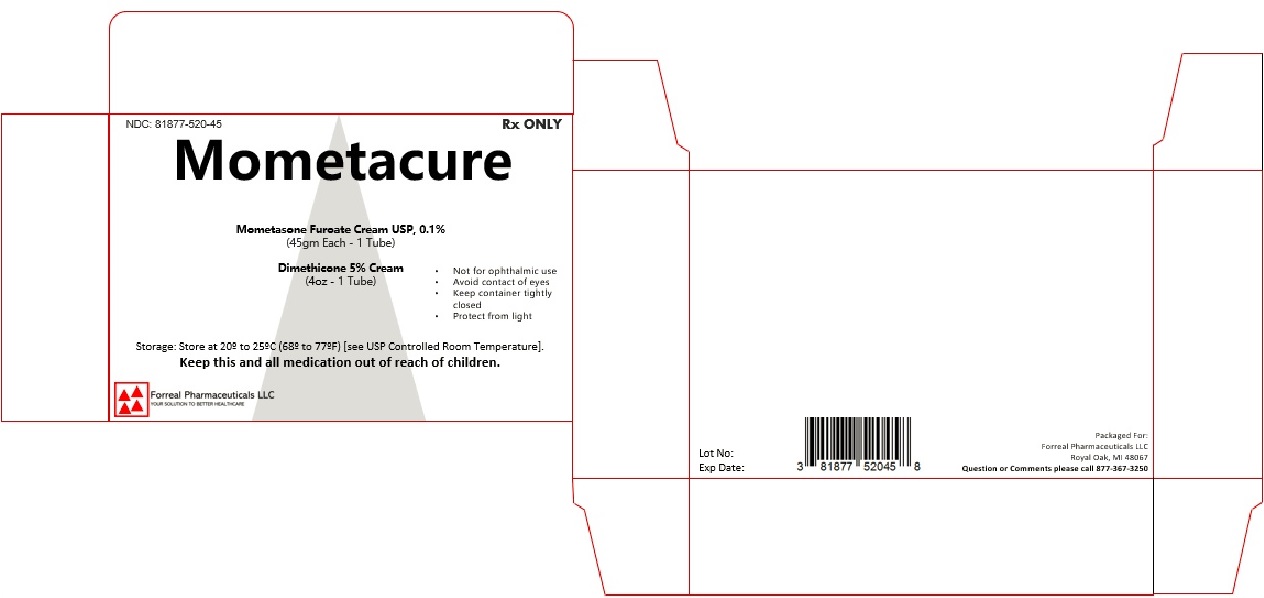
Mometasone Furoate Cream USP, 0.1% is white to off-white in color and supplied in 45-gram (NDC 81877-520-45) tubes; boxes of one.
Store at 20° to 25°C (68° to 77°F) [see USP Controlled Room Temperature]. Avoid excessive heat.