Mounjaro: What is it?
Mounjaro is a prescription medication designed to help manage type 2 diabetes in adults. The active ingredient, tirzepatide, is a dual GIP and GLP-1 receptor agonist. By enhancing insulin production and reducing blood sugar levels, Mounjaro helps improve glycemic control when used alongside a healthy diet and exercise. It is particularly effective for individuals who have not achieved desired results with other diabetes treatments.
Warnings and Crucial Information
Because of the potential for thyroid cancers, Mounjaro has a Boxed Warning.
Possible Thyroid Tumors (Including Cancer)
If you have shortness of breath, difficulty swallowing, hoarseness, or a lump or swelling in your neck, let your doctor know. These could be signs of thyroid cancer. Mounjaro (tirzepatide) and similar medications have been shown to produce thyroid tumors, including thyroid cancer, in rat trials. It is unknown if Mounjaro will result in thyroid tumors or medullary thyroid carcinoma (MTC), a kind of thyroid cancer.
If you or any member of your family has ever experienced medullary thyroid carcinoma (MTC) or Multiple Endocrine Neoplasia syndrome type 2 (MEN 2), an endocrine system disorder, avoid using Mounjaro.
Side Effects
Common Side Effects
The most common side effects of Mounjaro are:
- Diarrhea
- Vomiting
- Constipation
- Nausea (mild to moderate)
- Decreased appetite
- Abdominal pain.
Serious Adverse Reactions
Other significant adverse effects of Mounjaro include the following.
Inflammation of your Pancreas (Pancreatitis)
Patients receiving GLP-1 receptor agonists, including Mounjaro, have been observed to have pancreatic inflammation. If you experience signs of pancreatitis, such as persistent, intense stomach (abdominal) pain, either with or without nausea or vomiting, contact your doctor immediately. You may occasionally experience pain that travels from your abdomen to your back.
Low Blood Sugar (Hypoglycemia)
If you use Mounjaro with another medication that might lower blood sugar, like insulin or a sulfonylurea, your chance of developing low blood sugar may increase. Low blood sugar can manifest as the following signs or symptoms:
- Dizziness or lightheadedness
- Sweating
- Confusion or drowsiness
- Headache
- Blurred vision
- Slurred speech
- Shakiness
- Fast heartbeat
- Anxiety, irritability, mood changes
- Hunger
- Weakness
- Feeling jittery.
Serious Allergic Reactions (Anaphylaxis)
Anaphylaxis and angioedema are examples of severe hypersensitivity events that have been documented in patients receiving Mounjaro. If you experience any of the following signs of a severe allergic reaction, stop using Mounjaro and seek medical attention immediately:
- Swelling of your face, lips, tongue, or throat
- Problems breathing or swallowing
- Severe rash or itching
- Fainting or feeling dizzy
- Very rapid heartbeat.
Dehydration Leading to Kidney Problems
Dehydration, a loss of fluids brought on by diarrhea, nausea, and vomiting, may result in kidney issues. It is crucial that you stay hydrated in order to lower your risk of dehydration. Individuals who already have kidney disease, are elderly, or are on ACE inhibitors or diuretics are at higher risk. Along with consuming adequate amounts of fluids each day:
- Keep an eye on the color and volume of your urine. If your urine is dark yellow or you are not urinating as much as you usually do, speak with your doctor.
- If you experience persistent nausea, vomiting, or diarrhea, notify your healthcare professional immediately.
Severe Stomach Problems
Mounjaro use may be linked to stomach issues, some of which may be rather serious. For those with gastroparesis (slow stomach emptying), mounjaro is not advised. If you have severe or persistent stomach issues, let your doctor know.
Changes in Vision
Mounjaro has not been studied in individuals with diabetic macular edema, proliferative diabetic retinopathy, or nonproliferative diabetic retinopathy needing immediate therapy. You should have your condition closely watched if you have a history of diabetic retinopathy. GLP-1 medications like Mounjaro have been connected in safety reviews to non-arteritic anterior ischemic optic neuropathy (NAION), an uncommon eye disorder that can cause blindness.
If you have any changes in your vision while taking Mounjaro, let your doctor know right away. These changes could include:
- Sudden vision changes or vision loss
- Vision loss in one or both eyes
- Blind spots in your visual field
- Difficulty seeing colors
- Eye pain or pressure.
Gallbladder Problems
Some patients who took Mounjaro during clinical trials experienced gallbladder problems. If you have any of the following signs of gallbladder issues, let your doctor know immediately:
- Pain in your upper stomach (abdomen)
- Fever
- Yellowing of your skin or eyes (jaundice)
- Clay-colored stools.
Who Should Not Take Mounjaro?
Absolute Contraindications:
- Allergy to tirzepatide, Mounjaro, Zepbound, or any of the ingredients contained in the pens (see below for a list of ingredients)
- Personal or family history of medullary thyroid carcinoma (MTC)
- Multiple Endocrine Neoplasia syndrome type 2 (MEN 2).
Use with Caution:
- History of pancreatitis (severe abdominal pain)
- Severe kidney disease
- Gastroparesis or severe stomach problems
- History of gallbladder disease
- Diabetic retinopathy
- Pregnancy or breastfeeding.
The safety and efficacy of Mounjaro for children under the age of ten is unknown.
Pregnancy
If you become pregnant or intend to become pregnant while taking this medication, let your doctor know. The potential harm that this medication may cause to your fetus is unknown.
This medication may reduce the effectiveness of birth control tablets. Other birth control alternatives, such as an injection, implant, skin patch, vaginal ring, condom, diaphragm, cervical cap, or contraceptive sponge, should be discussed with your doctor. If you take birth control pills, you might need to utilize other birth control methods for four weeks after beginning the medication and for four weeks after each dose increase.
Breastfeeding
If you are nursing or intend to do so while taking this medication, let your doctor know.
- According to a clinical research, tirzepatide levels in breast milk were either negligible or undetectable in comparison to the mother’s dosage.
- There is no information on tirzepatide’s effects on breastfeeding babies or milk production.
- When making treatment decisions, medical professionals should balance the advantages of breastfeeding against Mounjaro’s mother’s medical needs, taking into account the mother’s underlying health condition and any potential hazards to the newborn.
How should I use Mounjaro?
You should carefully read the Instructions for Use and ask your doctor or pharmacist to clarify anything you don’t understand. It’s crucial to take this medication exactly as prescribed. Never take more or less of it or more frequently than your doctor recommends.
Mounjaro is a pre-filled pen that is injected subcutaneously (under the skin) using either the multidose Mounjaro KwikPen or a single-dose autoinjector pen.
- Mounjaro is usually given 1 time a week
- It can be given with or without meals at any time of the day
- It may be injected under the skin of the thigh, abdomen, or upper arm.
- You should rotate the injection site for each dose.
- A caregiver may give you Mounjaro injections, or you may self-inject if a healthcare provider determines that it is appropriate.
Typically, your doctor will start you on a low dose and raise it gradually, but no more than once every four weeks.
As long as there are at least three days between doses, you are free to switch up the day of the week you take this medication.
Insulin and this medication can be administered in the same location, but they shouldn’t be administered adjacent to one another. Avoid combining Mounjaro with insulin in one injection.
Mounjaro does not treat type 2 diabetes, but it does manage it. Before you experience the full benefits of this medication, it can take up to four weeks. Even if you feel well, keep taking this medication. Do not discontinue using this medication without first consulting your physician.
Dosing Information
Dose of Mounjaro for Type 2 Diabetes (Adults and Children 10+)
- Initial dose: 2.5 mg subcutaneously once a week.
- After 4 weeks: Increase to 5 mg subcutaneously once a week.
- If additional glycemic control is needed: Increase from 5 mg to 7.5 mg subcutaneously for 4 weeks and thereafter in 2.5 mg increments after at least 4 weeks on the current dose.
- Maximum dose (Adults): 15 mg subcutaneously once a week.
- Maximum dose (Pediatrics 10+): 10 mg subcutaneously once a week.
Comments: The 2.5 mg dosage is for starting treatment and is not intended for glycemic control.
If necessary, the weekly administration day may be varied as long as there is a minimum of three days (72 hours) between doses.
What strengths are Mounjaro pens?
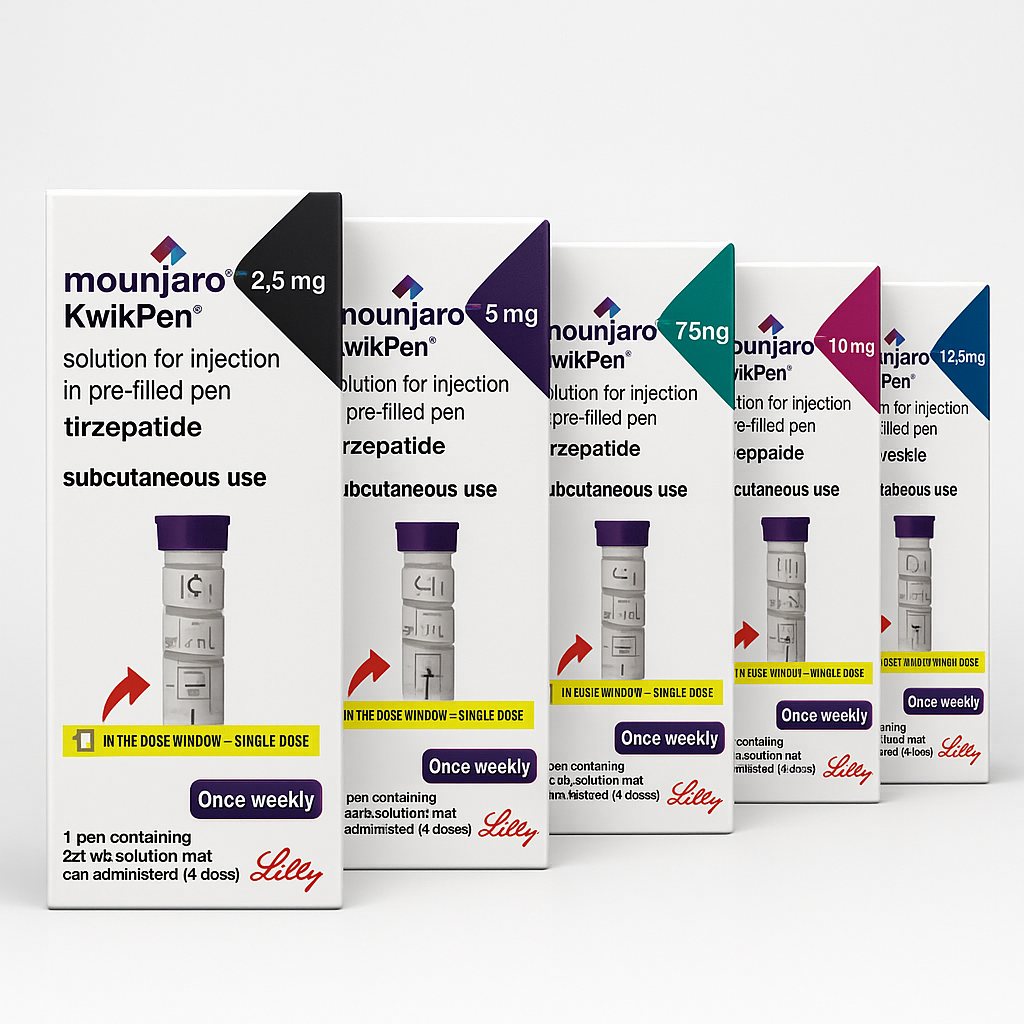
Mounjaro comes in the following strengths as a single-dose vial or autoinjector pen:
- 2.5 mg/0.5 mL
- 5 mg/0.5 mL
- 7.5 mg/0.5 mL
- 10 mg/0.5 mL
- 12.5 mg/0.5 mL
- 15 mg/0.5 mL.
Mounjaro is also accessible as the Mounjaro KwikPen, a subcutaneous multi-dose prefilled pen.
- Each pen contains 4 fixed doses, and one dose is injected weekly.
The single-patient use Mounjaro KwikPen and multi-dose vial are available in the following strengths:
- 10 mg/2.4 mL (4.17 mg/mL) for 4 x 2.5 mg/0.6 mL doses
- 20 mg/2.4 mL (8.33 mg/mL) for 4 x 5 mg/0.6 mL doses
- 30 mg/2.4 mL (12.5 mg/mL) for 4 x 7.5 mg/0.6 mL doses
- 40 mg/2.4 mL (16.7 mg/mL) for 4 x 10 mg/0.6 mL doses
- 50 mg/2.4 mL (20.8 mg/mL) for 4 x 12.5 mg/0.6 mL doses
- 60 mg/2.4 mL (25 mg/mL) for 4 x 15 mg/0.6 mL doses.
Due to rising demand, there have previously been problems with Mounjaro availability, which has resulted in medicine shortages for certain strengths. This has been fixed.
What should I do if I miss a dose?
Within four days of the missed dose, take it as soon as you remember to do so.
On the other hand, skip the missing dose and stick to your usual dosing plan if more than four days have gone by. Avoid administering two doses within three days of one another.
What should I do in case of an overdose?
Call the poison control helpline in the event of an overdose. Additionally, information can be found online at Poison Help. Call right away if the sufferer has passed out, had a seizure, is having difficulty breathing, or cannot be roused.
What other drugs affect Mounjaro?
Inform your doctor and pharmacist about the vitamins, nutritional supplements, herbal items, and prescription and over-the-counter medications you now use or intend to take. Your doctor might need to adjust your prescription dosages or keep a close eye out for any negative side effects.
When taking Mounjaro, birth control pills might not function as well (see birth control interaction caution below). For four weeks following the commencement of this medication and for four weeks following any dose adjustment, your doctor might advise you to take an alternative method of birth control.
Your risk of low blood sugar may rise if you use other diabetes medications with this treatment, such as insulin, sulfonylureas, or other GLP-1 agonists like Ozempic (see Mounjaro vs. Ozempic). Discuss low blood sugar and its management with your physician and pharmacist.
This medication slows down the emptying of the stomach and may alter how other oral medications are absorbed.
This is not an exhaustive list. This medication may interact with numerous other medications, including vitamins, herbal items, and both prescription and over-the-counter medications.
Birth Control Interaction Warning: Oral Contraceptive Effectiveness Reduced
Important: Due to delayed stomach emptying, Mounjaro may lessen the efficacy of oral birth control tablets. Although this interaction has been known since the FDA’s first approval, more recent research has measured its magnitude:
- Approximately 20% decrease in overall exposure of oral contraceptives after a single 5 mg dose of Mounjaro.
Contraceptive recommendations:
- Switch to non-oral contraceptive methods (IUD, implant, injection, patch)
- Add barrier methods (condoms, diaphragm)
- Use alternative birth control for 4 weeks after starting and after each dose increase.
How do I store Mounjaro?
- Store Mounjaro in the original carton to protect it from light.
- Do not freeze Mounjaro. Do not use Mounjaro if frozen.
- Store each single-dose pen or single-dose vial in the refrigerator between 36⁰F and 46⁰F (2⁰C and 8⁰C). If needed, each single-dose pen or single-dose vial can be stored at room temperature up to 86⁰F (30⁰C) for up to 21 days.
- Store multi-dose vial in the refrigerator between 36°F and 46°F (2°C and 8°C) or at room temperature [up to 86°F (30°C)]. Throw away the multi-dose vial after a total of 30 days at room temperature, 30 days after first use, or after taking 4 weekly doses, even if it still has medicine in it.
Keep out of reach of children.